GwG · Lawyers · Level 1 of 5

GwG for lawyers: Introduction

Introduction: Money laundering prevention in legal engagements

You learn to establish the actual legal service first and to check how it falls within the list of activities in section 2(1), no. 10 GwG, using the original text. You then identify the client, the representative and the other parties involved.

Training offer for Germany

Planned training time
3 hours
Additional test
Voluntary · planned +30 minutes
After participation
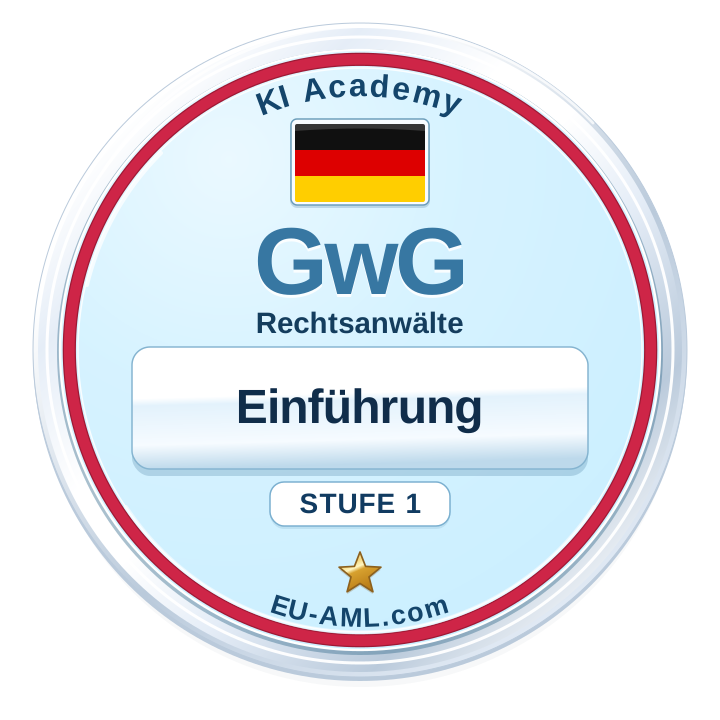
Participation certificate and participation Badge
Non-binding request to Timo Winkelbach. You can only select the additional exam if you wish.

GwG · Lawyers · Stage 1 · Introduction
Industry badge · 1 star marks the level of learning. This example image is not a personal proof and does not confirm passed examination.
Format and price for this level

At levels 1 and 2, choose between self-paced learning and live training. Levels 3 to 5 take place live online.

Online examination included in the price

All prices exclude statutory VAT. The live training price depends on the level and date and will be confirmed before booking.

Payment via PayPal after your booking is confirmed.

Up-to-date training materials

Certificate of attendance and digital badge

The final examination is optional and takes place online. One attempt and one retake are included in the course price. Examination time is additional to learning time.

12 months of access from the first course start

In the self-paced course, the times are guidelines for your own learning pace.

We use teaching case studies based on real practical questions. Individual advice on ongoing client matters is not provided during training.

Does this step fit you?

Who is the training for?

For lawyers, new entrants to the profession and law firm staff who accept engagements or prepare documents for assessment.

What prior knowledge do you need?

No prior knowledge of the GwG is required; you should be familiar with the basic procedures for accepting legal engagements.

Your concrete added value

You gain a clear sequence for accepting legal engagements. This helps you ask specifically about missing information and recognise when a professional decision by the responsible lawyer is required.

From the engagement to an initial assessment under money laundering law

That's what you're working on in this training.

  1. Activity and obliged entity status

    You compare brief descriptions of instructions involving litigation, corporate advice and business acquisitions. Using the statutory list of activities, you record which factual information is missing for classification and why a professional title alone does not replace the specific assessment.

  2. The client and the parties involved

    You work with a fictional engagement agreement, a power of attorney and a register extract. You distinguish the client, the person acting and the beneficial owner, and organise the initial questions about collecting and verifying information.

  3. Confidentiality and orderly disclosure

    You distinguish the assessment of obliged entity status from questions of legal professional confidentiality and a possible reporting obligation. A simple law firm example shows which points require internal clarification and how information and outstanding questions can be recorded clearly.

Your learning goals

  • Classify the specific engagement using the GwG list of activities.
  • Distinguish the client, the representative and the beneficial owner in the example.
  • Distinguish information collected from information verified in the file.
  • Recognise confidentiality and reporting issues as separate assessment points.

From knowledge to a well-founded case solution.

Fictional practice case · Lawyers

Business acquisition with a different invoice recipient

A managing director asks for assistance with a business acquisition. The invoice is to be addressed to a different company. Examine the activity requested and identify the client, the person acting and the intended payer, without treating this discrepancy alone as grounds for suspicion.

In focus: Classification by activity and initial clarification of the parties when accepting an engagement.

Your Exercise

You complete an intake form, identify missing documents and formulate factual questions for the fictional client, together with a point requiring internal clarification.

Your work result and proof of participation

An organised engagement intake form with a classification of the activity, an overview of the parties and a list of information still needed. After completing the training, you receive a participation certificate and a participation Badge for your sector and level.

How this relates to your daily work

The sequence you develop supports the preparation of new engagements and clear follow-up questions within the law firm. You also recognise which information is not substantiated by a file note alone.

Live online training

Planned: 3 hours of training. With room for application.

The planned training period is 180 minutes. It includes knowledge transfer, application at the practice case and joint evaluation. Breaks are added. The data are planning values; we coordinate the concrete process before the training.

Knowledge & Classification
75 minutes
Exercise & Application
90 minutes
Evaluation & Transfer
15 minutes

If you choose the optional additional exam, come 30 minutes The planned total time with examination is then 3.5 hours, plus breaks.

Self-paced online course
In the self-paced course, the times are guidelines for your own learning pace.

The final examination is optional and takes place online. One attempt and one retake are included in the course price. Examination time is additional to learning time.

Voluntary additional option · planned +30 minutes

You decide if you're going to take an additional exam.

Training is also possible without additional final examination. After completing your training you will receive a certificate of participation and a badge of participation. A proof of passing an examination requires successful participation in the voluntary supplementary examination.

Test format

Optional assessment: knowledge questions and a short independent legal engagement case

Your exam task

You work on a new description of an engagement and explain the classification of the activity, the information required and the next internal step.

This is what the evaluation depends on.

  • List of activities examined case-by-case
  • Clearly distinguish the roles of the parties
  • Identify information gaps and responsibilities

Documentation of the test performance

After passing the optional assessment, you receive a record of achievement for this level explicitly identified as an assessment credential.

Request training with additional examination

Participation and examination performance remain recognizable.

The personal proof explicitly indicates whether the participation or a passed voluntary supplementary examination is confirmed. The badge graphic shows the industry and level of learning; it is not in itself a proof of performance.

Information about certificate and Badge verification →

Your badge shows the training series, sector and learning level. Together with your personal certificate, you can make your completed training visible in your CV or career profile.

Learn more about certificates and badges →

Interested in GwG for lawyers: Introduction?

Your contact for the training request is Timo Winkelbach. You can reach him by e-mail to info@eu-aml.com or via the pre-filled request form.

Prepare training request

Series, industry and level are taken over. The request is non-binding.

View all five levels for lawyers →

24 OFFICIAL LANGUAGES

Select the language of the website

Training courses and examinations are conducted exclusively in German.

The language selection applies to the information on this website. Original graphics, badges and cited German legal texts remain unchanged.

The translations are for information purposes. In the case of technical questions, the original German version remains decisive.